

Our lovely misspelt logo by Dall-E
Hi,
Welcome to the Procrastilearning Newsletter, where your time is well spent even though you should probably be doing something else.
3 things worth procrastilearning over

via Leonardo.ai
1. We're in the age of the passive Internet
Do you remember how a few years ago, not having a TV was seen as a mark of discernment? 'Oh, we don't have a TV anymore,' your friend scoffed, now wearing a monocle for some reason. 'There's nothing on TV that would interest me.'
Well, those days are gone, because today we are all watching TV on our phones thanks to the rise of short-form video content. That's the basic premise of Derek Thompson's recent Everything is Television article.

The evidence is depressingly clear. The majority of social media use is flicking through videos now. And most of it isn't made by people we know anymore - plus lots of it is AI. The social aspect of social media is disappearing. It's just random entertainment you flick through, but now you're staring at the remote itself instead of the TV.
What's mad is that right now we’re also completely swamped by cheap and often free tools that could make all of us creators. But only a handful of people are embracing that opportunity. Most of us are sinking into an age of Internet passivity. We could be crafting, building, producing, but we’d rather just be spectators and flick to the next video. Maybe it’s tiredness, maybe it’s human nature, or maybe it’s just the path of least resistance. Whatever it is, TV is back, baby. And it’s not going away anytime soon.
P.s. congratulations on opening this newsletter instead of YouTube Shorts again 😁
2. Vending machines are 2000 years old

The history of vending machines is much older than you thought. In the first century AD, Hero of Alexandria built a coin-operated holy water dispenser so that people in temples couldn’t over-pour from sacred taps. Then the world took a 1,600‑year break, possibly due to all those plagues. In the 1600s though, England added nicotine to the mix with coin‑operated tobacco dispensers, quietly proving that if you combine automation with mildly addictive substances, the business model more or less writes itself. I think this was later noted by the inventors of the fruit machine and Farmville.
By the 1880s, things got a bit Industrial Revolution-y. Percival Everitt’s machines in London started spitting out postcards, envelopes and notepaper in railway stations, and suddenly everyday life was full of these little metal boxes selling whatever people couldn’t stop buying: chewing gum, cigarettes, stamps, and later snacks and drinks.
After that, vending went global. Japan embraced the format so enthusiastically that you can now find them on just about every street, some even offering farm‑fresh eggs, batteries and booze (I saw the latter in Kyoto). Infamously, Japan also had used underwear machines in adult shops in the 1990s, although they were soon regulated into almost total extinction.

Today, where vending machines really excel seems to be airports. Even the tiny airport in Lublin in Poland has a vending machine offering dress shirts. My own favourite vending machine discovery was the freshly-cooked pizza vending machine I happily made use of in Helsinki Airport.
I wonder what Hero of Alexandria would have made of it all.
3. Drone deliveries are already huge in China
The UK and US have spent the past decade talking about ‘the future of drone delivery’ like it’s just around the corner, while mostly using drones for all their wars. Amazon’s delivery drones in the UK, for example, are only now tiptoeing into limited trials in places like Darlington after years of promises, regulatory bottlenecks and carefully fenced-off airspace.
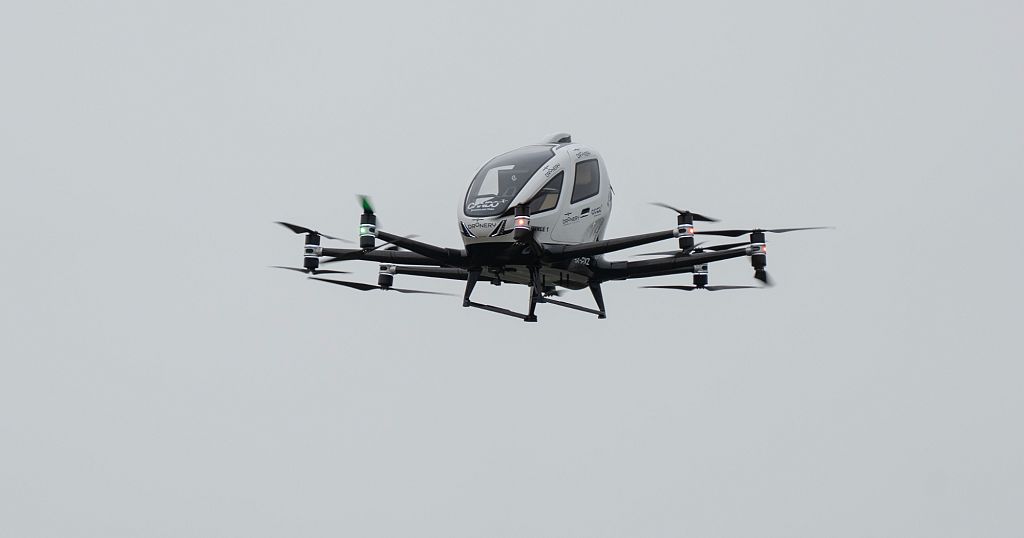
China, meanwhile, seems to have skipped the test phase completely and gone straight to ‘Oh, these things are everywhere now’. In cities like Shenzhen, drones have moved from experiment to everyday infrastructure: by late 2024, one food-delivery platform alone had completed over 200,000 drone orders on more than 50 routes, and the city logged around 8,000 drone flights per day across corporate and private users. Local authorities talk about a ‘low-altitude economy’ with a straight face, and companies iterate fast because the regulatory environment is so lax.
Stand on a UK pavement and you might catch a glimpse of a single test drone if you’re near that one town on the rollout map. Stand on a Shenzhen balcony and you can literally watch the sky filling up with flying takeaway and parcels, a clear visual of what happens when a state decides ‘F*** it, let’s just do this’ and worries about NIMBYs, rights and pollution later.
2 quotes to keep in mind
Action seems to follow feeling, but really action and feeling go together; and by regulating the action, which is under the more direct control of the will, we can indirectly regulate the feeling, which is not.
If you ever feel useless, remember it took 20 years, trillions of dollars and 4 US Presidents to replace the Taliban with the Taliban.
1 simple tip for improving your meetings
Have them while walking.
Research shows how walking boosts creativity and problem-solving by up to 60%, so wouldn't that be useful during a brainstorming meeting? While it may not be possible to get the entire accounts department to go on a walk with you, it might revolutionise your 1-on-1 meetings. The walking factor can also be incorporated in other ways into your meetings - make your business calls while walking. If you need your computer, get a standing desk and a basic treadmill (they are weirdly cheap now).
Either way, next time you have a meeting, try and imagine you are filming a scene from The West Wing.

That's all for today. Many thanks for reading.
Adam
Adam Zulawski
Procrastilearning on Beehiiv / More stuff
Sent this by somebody else?
